Sunday, July 13, 2014

Sunday, June 29, 2014
American Fast Food in Asia or the Chicken Story
 |
| KFC in a traditional traditional Minnan style structure http://www.vagabondjourney.com/ |
I recently was reading some blog posts by other bloggers and came across some interesting postings of American fast food outlets in Asia, notably China. Many writers complain about the ubiquity of fast food brands across the globe, seeing them as the ultimate symbol of American imperialism. Some may say they dilute local culture, threaten culinary heritage and encourage unhealthy dietary habits.
But there is more going on than you may think between China and the US as far as American fast food exports and foreign imports. The more I looked into the fast food expansion in Asia the more interesting it became to me.
 |
| Yes you can get a Big Mac in Beijing |
In China American chain restaurants like KFC, McDonald’s, Pizza Hut, and Starbucks, as well as many Chinese fast-food chain restaurants that are (surprise) similar looking to some American brands have sprouted up everywhere in China. The Chinese chains have picked up on the American concept of inexpensive, standardized food items served in disposable paper and plastic convenience. China has also adapted the fast-food approach to its own cuisine. Chinese street food vendors offer dumplings and noodle soup served in a bowl lined with plastic. This allows the bowl to be reused by just putting a new plastic bag. Slick, no need to wash the bowl between customers. Street food in Asia is a wondrous sight if not amusing at times.
Last year I mentioned in my "Fan with Soy" blog posts about seeing restaurant chains in Japan that are no longer found in the US, Bob's Big Boy, and about competing 7-11 stores on opposite corners in Bangkok. I also mentioned that Shaq was the spokesperson for Harbin Beer which is an NBA (yes, basketball) sponsor. The Harbin brewery is owned by Anheuser–Busch InBev, which has helped to export Harbin beer to European and North American markets.
Harbin Beer probably wasn't really looking to be part of the InBev product line but was probably looking for some capital for expansion. Well they got that and meanwhile the US opened more fast food outlets under YUM!Brands, Inc in China. Yum! is a United States-based Fortune 500 corporation and operates four licenses Taco Bell, KFC, Pizza Hut, and WingStreet restaurants worldwide.
Okay, so what is so bad about YUM!Brands? Well again not much unless you think about the absurdity of some of the locations. The company opened its first restaurant in Ulaanbaatar, Mongolia in May, 2013. For Mongolia, KFC is the first western fast food to open its doors in the country. The company is planning to open 15 more restaurants in Ulaanbaatar in the next 5 years, including the country's first drive-thru service. Mongolia?!?
 |
| Shaq as the spokesperson for Harbin Beer |
 |
| Note the NBA logo at the bottom of the can |
 |
| Yep, food on a stick or a stick on a stick. |
Now this expansion in China and the rest of Asia hasn't translated in absurd profits for either McDonalds or YUM!. When fast-food giants McDonald’s Corp. and Yum! Brands Inc. reported fourth-quarter and full-year results for 2013, both chains said that US sales were flat at best for both periods. When McDonald’s reported January same-store sales Monday morning, US same-store sales were down 3.3% compared with January 2013 sales.
McDonald’s reported that same-store sales in China were flat in the fourth quarter, while Yum! said that its sales in China were down 4% in the quarter and 13% for the full year. Both companies have been hit by concerns over avian flu and tainted chicken supplies that surfaced late in 2012. Yum! was hit harder, and it has taken the company a full year to climb back to its relatively small sales decline last quarter. With some 3,700 stores in China, more than half of YUM's business now comes from KFC China, 44% revenue and 50% profits, to be specific. And now it occupies half of the total fast-food industry in China. For every million people in China there are only 3.5 YUM! restaurants, compared with 58 in the US.
McDonald’s reported that same-store sales in China were flat in the fourth quarter, while Yum! said that its sales in China were down 4% in the quarter and 13% for the full year. Both companies have been hit by concerns over avian flu and tainted chicken supplies that surfaced late in 2012. Yum! was hit harder, and it has taken the company a full year to climb back to its relatively small sales decline last quarter. With some 3,700 stores in China, more than half of YUM's business now comes from KFC China, 44% revenue and 50% profits, to be specific. And now it occupies half of the total fast-food industry in China. For every million people in China there are only 3.5 YUM! restaurants, compared with 58 in the US.
But for the suppliers of chicken both here in the US and China there is another hidden story. Here is an article by BETTINA ELIAS SIEGEL about processed chicken sold in the US.
USDA Misinforms Parents About Chinese-Processed Chicken in School Meals
On August 30, the USDA announced that it will allow four Chinese facilities to process poultry raised and slaughtered in the United States, Chile or Canada, and then export the cooked poultry products back into the United States. The USDA’s move is widely seen as a preliminary step toward eventually allowing China to export its own raw poultry into this country, in exchange for China’s opening up its lucrative beef market to American beef producers.
Given China’s troubling food safety record and the fact that its own government official essentially admitted that China can’t live up to the food safety standards of more developed nations, there are those who speculate that the timing of the USDA announcement – the Friday before Labor Day weekend — was not unintentional. But whether or not the agency was trying to bury this news, the announcement quickly led to an outcry among journalists, environmental watchdog groups and Congressional representatives, including New York Senator Charles Schumer (D), Ohio Senator Sherrod Brown (D) and Connecticut Congresswoman Rosa DeLauro (D).
In the days following the announcement, a few readers asked me if the new USDA policy means that Chinese-processed chicken will appear on American school lunch trays. On the USDA’s Food Safety and Inspection Service (FSIS) website, I found this helpful Q & A:
Will chicken processed in China be included in school lunches?
No. The USDA’s Agricultural Marketing Service ensures that products included in [sic] school lunch program are produced, raised, and processed only in the United States, its territories or possessions, the Commonwealth of Puerto Rico, or the Trust Territories of the Pacific Islands.
To parents with little knowledge of how school food programs operate (i.e., the vast majority), this statement from FSIS would seem to settle the question — and provide solid reassurance for those concerned about Chinese-processed chicken being fed to their kids at school.
But the FSIS statement is in fact quite misleading.
It is true that school districts participating in the National School Lunch Program (the “NSLP,” which also includes school breakfast and after-school snack programs) receive agricultural commodities from the USDA’s Agricultural Marketing Service, and it is true that these products are domestic. But the USDA is well aware that school districts also procure significant portions of their school food from private vendors, and this method of school food sourcing is entirely omitted from the answer above — despite the blanket “no” response.
So the pertinent question is: Can private vendors sell Chinese-processed chicken to schools?
I emailed the FSIS and a USDA spokesperson agreed that “schools also make their own purchases” of school food, but she went on to note that such purchases are governed by a “Buy American” regulation which
requires participating schools to purchase domestically grown and processed foods, to the maximum extent practicable. A domestic . . . product is defined to be “. . . a food product that is processed in the United States substantially using agricultural commodities that are produced in the United States.”
This regulation sounds like a de facto ban on Chinese-processed chicken. But at the end of her email, the spokesperson also disclosed that under the “Buy American” rule:
[p]roducts that are processed in the United States and comprised of at least 51 percent domestic ingredients are considered domestic.
I have since expressly confirmed with the USDA that this definition of “domestic” would indeed allow Chinese-processed chicken into the school lunch program. Here’s how: if, for example, a manufacturer of frozen chicken egg rolls fully assembles the egg rolls in this country, but sources the cooked chicken in the egg rolls from a Chinese processor, the egg rolls are considered “domestic” so long as the Chinese-processed chicken doesn’t comprise more than 49% of the total product. School districts could buy these egg rolls without violating the “Buy American” rule and the egg rolls would not have to bear any country-of-origin labeling to disclose the location of the poultry processing. And this scenario could easily apply to any chicken-based entree supplied to schools, such as chicken soup, frozen chicken burritos, chicken chili, chicken-stuffed ravioli, and more.
I also learned that there’s a second exception to the “Buy American” rule. In the unlikely event that the economics of chicken processing shift, such that it becomes reliably cheaper for schools to source items like patties and nuggets using Chinese-processed chicken over domestically processed chicken, then schools can freely buy such products, regardless of ingredient percentages.
So the bottom line is this: despite the blanket reassurance to the contrary on FSIS’s website, it is entirely possible that Chinese-processed chicken will be used in school meals.
It’s also worth noting that, according to the USDA spokesperson, there is no analogous “Buy American” restriction on schools providing evening meals to students, nor does it apply to meals served in day care centers, as both of these programs are part of the Child and Adult Care Food Program rather than the NSLP. (“School supper” programs are increasingly common; by 2015, an estimated 21 million students will be eating dinner at school.) Accordingly, it appears that any Chinese-processed chicken product, regardless of ingredient percentages, can be used in these meals as well.
Whether Chinese-processed chicken presents a serious concern for parents is open for debate. According to sources interviewed by Politico, few U.S. poultry producers have expressed interest in processing chicken in China at the present time due to logistical constraints. If that situation changes, however, parents are unlikely to know about it. Moreover, because no country-of-origin labeling is required on products containing Chinese-processed chicken, only school districts which expressly obligate vendors to use 100% domestically processed chicken will know exactly what they’re serving to kids.
In my opinion, though, parents ought to be far more worried about the possible lifting of the export ban on Chinese-raised and -slaughtered raw poultry. If raw Chinese poultry enters this country and becomes reliably cheaper than domestic poultry, its use in school food could become widespread under the second exception to the “Buy American” rule noted above. (And, at any rate, raw Chinese poultry could always be used, up to 49%, in manufactured food items regardless of cost.) Given that some Chinese poultry farmers allegedly used large quantities of illegal drugs in raising chickens sold to KFC, and given the potential vulnerability of young school children eating such chicken, a lifting of the export ban on raw Chinese poultry is a cause for serious concern.
In the meantime, is FSIS intentionally misleading the public on this issue? I can’t know, of course, but I suspect that in the rush to quell concerns about the August 30th announcement, the FSIS simply failed to vet its school food Q & A with the USDA’s Food and Nutrition Service, the branch of the agency overseeing child nutrition programs. Regardless of motive, however, my own questioning of the agency (which began a full two weeks ago) has clearly brought the inaccuracy to its attention — yet, as of this writing, the original statement remains on its website.
Will chicken processed in China be included in school lunches?
No. The USDA’s Agricultural Marketing Service ensures that products included in [sic] school lunch program are produced, raised, and processed only in the United States, its territories or possessions, the Commonwealth of Puerto Rico, or the Trust Territories of the Pacific Islands.
requires participating schools to purchase domestically grown and processed foods, to the maximum extent practicable. A domestic . . . product is defined to be “. . . a food product that is processed in the United States substantially using agricultural commodities that are produced in the United States.”
[p]roducts that are processed in the United States and comprised of at least 51 percent domestic ingredients are considered domestic.
So are these fast food outlets really contributing to bad dietary habits? Probably yes but considering the amount of disposal income in China and much of Asia not everyone nor is every meal being eaten in a fast food restaurant though I can't say the same happens in the US. Statistics do show an increase in obesity in some areas of China. Then there are other indicators that say it is not the fast food but other environmental factors that contribute to the increase in obesity.
Should the US be concerned about processing chickens in China then shipping them back? Again probably yes. But as the article says you may not know where your food comes from even if it is labelled. So the concern should be with the US regulations that allow this type of labelling or lack there of.
I will have to admit that as a traveller seeing a familiar US brand while travelling overseas can be comforting. But you may need to tone down your expectations. Some of the worst coffee I have ever drunk was from a McDonalds in Italy. I know I committed a sin in a country that can make good coffee. When I took my son to Amsterdam the first meal he wanted was from a Subway and I let him do it, though only once. And many of these familiar chains are filled with Americans looking for something like home.
Sometimes it is lonely to be a Stranger in a Strange land.
And for some amusement follow this link to some of the most unusual McDonalds locations.
If you have read this blog post so far thanks as I know it is a long one. This may be the last "Fan with Soy" post using the Blogger platform as I am going to focus on the "Adventures in Europe - Part 3" blog and move to everything to a WordPress platform (as soon as I can figure out how to do it).
Should the US be concerned about processing chickens in China then shipping them back? Again probably yes. But as the article says you may not know where your food comes from even if it is labelled. So the concern should be with the US regulations that allow this type of labelling or lack there of.
I will have to admit that as a traveller seeing a familiar US brand while travelling overseas can be comforting. But you may need to tone down your expectations. Some of the worst coffee I have ever drunk was from a McDonalds in Italy. I know I committed a sin in a country that can make good coffee. When I took my son to Amsterdam the first meal he wanted was from a Subway and I let him do it, though only once. And many of these familiar chains are filled with Americans looking for something like home.
Sometimes it is lonely to be a Stranger in a Strange land.
 |
| Note the travellers not from China eating here. |
And for some amusement follow this link to some of the most unusual McDonalds locations.
If you have read this blog post so far thanks as I know it is a long one. This may be the last "Fan with Soy" post using the Blogger platform as I am going to focus on the "Adventures in Europe - Part 3" blog and move to everything to a WordPress platform (as soon as I can figure out how to do it).
Saturday, April 19, 2014
China's Modern Ghost Cties
Update Aug 2014:
60 minutes covered this subject
http://www.cbsnews.com/news/china-real-estate-bubble-lesley-stahl-60-minutes/
The Fengdu Ghost City is a tourist attraction about 170 kilometres (110 mi) downstream from Chongqing on the north bank of the Yangtze River. It is an attraction that we were able to see during our 2002 cruise tour along the Yangtze River. Legends said that Ming Mountain is one of the 72 graveyards for Taoism. Tao believes when people die, their spirits will gather there (also called "spirit world"). All the temples were built at Western Jin period (265 ~ 420A.D.) and rebuilt in Ming and Ch'ing Dynasty (1386 ~ 1911A.D.)
The City of Ghosts was a place of worship before the flooding of the Three Gorges due to the Three Gorges Dam Project. Today it is a tourist attraction the Chinese and foreigners visiting the Three Gorges on their Holidays. The site has been almost entirely rebuilt and replicated from the original city that now sits 70 metres below the waters surface.
China's Italian Ghost City
China's Empty Cities
Shanghai's German city
But not all are apparently true ghost cities just not fully inhabited - or so they say.
60 minutes covered this subject
http://www.cbsnews.com/news/china-real-estate-bubble-lesley-stahl-60-minutes/
The Fengdu Ghost City is a tourist attraction about 170 kilometres (110 mi) downstream from Chongqing on the north bank of the Yangtze River. It is an attraction that we were able to see during our 2002 cruise tour along the Yangtze River. Legends said that Ming Mountain is one of the 72 graveyards for Taoism. Tao believes when people die, their spirits will gather there (also called "spirit world"). All the temples were built at Western Jin period (265 ~ 420A.D.) and rebuilt in Ming and Ch'ing Dynasty (1386 ~ 1911A.D.)
The City of Ghosts was a place of worship before the flooding of the Three Gorges due to the Three Gorges Dam Project. Today it is a tourist attraction the Chinese and foreigners visiting the Three Gorges on their Holidays. The site has been almost entirely rebuilt and replicated from the original city that now sits 70 metres below the waters surface.
Fengdu is the only ghost city in China. The temples are all over the mountain with many statues. In the "spirit world", there are series of super beings in the temples. They all have its own responsibility, they guard the spirit world.
But wait there are more ghost cities in China. On our way to the Shanghai airport I noticed several large building complexes that did not seem to be occupied. Our guide noticed that I was looking at the buildings and her comment was that the farmers got rich by selling the land for apartments. Great but there wasn't any transportation going to or from these "cities" nor did I see any cars or in fact any traffic moving. Here are a few videos from other explorers that noticed the same thing.But not all are apparently true ghost cities just not fully inhabited - or so they say.
When will there be a new post?
Okay, for those who really like to follow this blog just a quick update. The Adventures in Europe-Part 3 will be taking most of my time for the most of this year as we are getting ready for an intensive trip again!!! As always I hope to find time to update this blog with some interesting highlights and what our RTW trip will look like for 2015-2016.
There may still be one more update this year as we will be in Istanbul Turkey and I hope to get over to the Asian side at least once. Those of you who just said "there is an Asian-side?" the answer is yes. But on the whole we will be spending the majority of our time in Europe and you can keep up by following: aeup3.blogspot.com.
This trip will include Italy, Turkey, Greece, Croatia, Spain, and Morocco. So what are the difficulties this time you may ask. Well we are planning to be in Sorrento during the high season and will try to travel from Salerno to Sorrento by ferry and bus. Will let you know how that goes. Turkey is still a wild card as far as how the political scene as is Morocco.
So stay tuned and happy trails!
There may still be one more update this year as we will be in Istanbul Turkey and I hope to get over to the Asian side at least once. Those of you who just said "there is an Asian-side?" the answer is yes. But on the whole we will be spending the majority of our time in Europe and you can keep up by following: aeup3.blogspot.com.
This trip will include Italy, Turkey, Greece, Croatia, Spain, and Morocco. So what are the difficulties this time you may ask. Well we are planning to be in Sorrento during the high season and will try to travel from Salerno to Sorrento by ferry and bus. Will let you know how that goes. Turkey is still a wild card as far as how the political scene as is Morocco.
So stay tuned and happy trails!
Tuesday, January 28, 2014
Krung Thep Maha Nakhon or better known as Bangkok
City of Angels not resting
Bangkok and from what I saw is a 24/7 city and is back in the news again for protests against the government and the upcoming elections. We were glad that the time we were in Bangkok there were no protests or other signs of unrest but there was lots and lots of traffic. This was not to say that there weren't any pedestrians or bicyclists on the streets but when there was it was a dicey way to get around.But remember they all love their King and the majority of the population has not seen any of the film versions nor have read the book "The King and I".
Here are some photos taken from our hotel window early in the morning.


But there is an upside to all of the protests albeit a minor one but one that has changed the life of some Bangkok residents - street closures. What is so great about street closures well for one it has allowed more bicycling around the city. While we were in Bangkok we spent a fair amount of time sitting in a taxi going nowhere really fast. To be fair we did not try the metro system but that was mostly due to the system not going where we wanted to go and our tour group insisting on using taxis.
In a city where more than half of the daily commuters rely on private transport to and from work, Bangkok traffic has become the lightest in years after the closure of seven main intersections. Since the closure of main intersections in the inner city, except at Government Complex on Chaeng Wattana Road, Bangkok residents have learned to look at their city with a new perspective. The capital... click for article
http://www.bangkokpost.com/lifestyle/family/391816/copenhagen-of-the-east

How did Bangkok get its name?
Though the correct name for this city is: Krungthepmahanakhon Amonrattanakosin Mahintharayutthaya Mahadilokphop Noppharatratchathaniburirom Udomratchaniwetmahasathan Amonphimanawatansathit Sakkathattiyawitsanukamprasit and is listed as the world's longest location name by the Guinness Book of Records. Translated to English the name goes like this: "The city of angels, the great city, the residence of the Emerald Buddha, the impregnable city of Ayutthaya of God Indra, the grand capital of the world endowed with nine precious gems, the happy city, abounding in an enormous Royal Palace that resembles the heavenly abode where reigns the reincarnated god, a city given by Indra and built by Vishnukarn".
Krung Thep is the abbreviated version of the ceremonial full name, which is shown below. กรุงเทพมหานคร อมรรัตนโกสินทร์ มหินทรายุธยามหาดิลก ภพนพรัตน์ ราชธานีบุรีรมย์ อุดมราชนิเวศน์ มหาสถาน อมรพิมาน อวตารสถิต สักกะทัตติยะ วิษณุกรรมประสิทธิ์.
Bangkok (translating as 'village of wild plums') was the original site for the capital city and was located west of the Chao Phraya river (in modern day Thonburi). In 1782, King Rama I decided to move to a more defensible site and moved across the river to found his new capital, Krung Thep. For whatever reason, foreigners have never bothered to use the name change and the old name of Bangkok has stuck. In recent years, Krung Thep/Bangkok has expanded at such a fast rate that it now sprawls over a huge mass of land on both the sides of the Chao Phraya and has engulfed the once independent Thonburi. So given the length of it, it's not hard to see why it's shortened in everyday use. The full name itself is never actually used, though it can be seen on a few signs around Bangkok as part of a tourist campaign. Another version, Krung Thep Mahanakhon, is quite common in official documents, car number plates and the like. Despite the length of it, an impressive number of Thai people are still able to recite the entire name off by heart as our local guide did for us. They wouldn't necessarily understand what it means though, as many of the words are archaic and no longer used in modern Thai.
Friday, May 31, 2013
Angkor Archaeological Park
*********************************************************************************
New link by Google takes you to the temples at Siem Reap. Very stunning views
http://www.google.com/maps/about/behind-the-scenes/streetview/treks/angkor/
*********************************************************************************
Everywhere you look in the Angkor Archaeological Park the strong influence of India is seen detailed in the temple architecture and in the carvings depicting the Ramayana, Buddha, and other Dravidian imagery. The structure of some temples resembles the structure of Mount Meru. Temples were built at an elevated level because they believe Gods must be at a much higher plane than humans. But now we humans are allowed to climb these towers and enjoy the expansive views.
Here are a few photos of the park. More explanations of what and where in the temple complex the photos were taken is detailed in the page titled Angkor temples or at through this link Angkor temple guide.

 |
| Demons at Angkor Thom South Gate |
 |
| Gods at Angkor Thom South Gate |
 |
| South Gate to Angkor Thom |
 |
| Airavata brining rain to man |
 |
| Bayon |


 |
| Khmer army |


 |
| Garuda |


 |
| Baphuon |

 |
| Phimeanakas |


 |
| Elephant Terrace |

 |
| Tree covering temple at Ta Phrom |
 |
| Ta Phrom |
 |
| Entering Angkor Wat |

 |
| Bas relief of the Ramayana |


Thursday, May 30, 2013
The Party Line and other political statements
So like many tourists visiting a foreign country and unfamiliar with the local language we hired local guides while touring Asia. None of the guides were known to us prior to our arrival and not much information regarding who we were was given to the guides. They were all excellent English speakers and were very helpful in getting to the train station or airport on time.
Briefly, the usual routine when first meeting our local guides is for the guide to ask where are you from, where have you traveled to or where are you traveling to next. Often their response, once you tell them where you have been or where you are going to, is "that is wonderful and you will like..." but not "the situation between our two countries is a little tense at this moment." However, traveling in Asia at this point in time is interesting in a geopolitical sense.
But let us also not forget about the American political speak of late. Of course the US government is completely innocent of contributing to any of the geopolitical situations mentioned here, right.
Speak softly but deny
Our adventure in Japan included visiting historical or cultural sites and all of the Japanese guides with one exception were well educated females. In typical Japanese fashion their initial comment about our continued travels to China were "The Japanese don't travel to China now that there is a disagreements over the disputed territories." Benign and to the point without being rude. Very typical of how a Japanese person would say something that could ignite controversy. Not that the political leaders of Japan haven't used similar benign words to describe Japanese war time activities like "comfort women" being a military necessity.
But the Japanese rhetoric was a sharp contrast to what our Shanghai guide had to say.
Just be blunt
Our trip to Shanghai was a follow-up trip to our 2002 trip. Back in 2002 our desire was to see what life was like along the Yangtze River before the completion of the Three Gorges Dam project and to see some of the major cities in China like Beijing and Shanghai. We enjoyed our first visit but we were quite dismayed with the changes to China eleven years later. Shanghai had gone from a city starting to modernize to a full blown metropolis filled with modern high office buildings to row upon row of multi-story apartment buildings. Of course being in Shanghai during Chinese New Year may not have been the best to visit Shanghai.
Our Shanghai guide is a native Shanghainese and vocally expressed her opinions regarding the Japanese in China. Some of her anti-Japanese comments were based on a personal experience but nonetheless made me feel rather uncomfortable. She felt the Japanese had no right to the disputed island and went to say how Shanghai was being impacted by Japan and Japanese businesses located in China. And the best example was the World Financial Center in Pudong.
Here is a photo of the Pudong area of Shanghai.


Sure seems like a lot of people getting their panties in a bunch but then.....
.... what about the new People's Daily newspaper building? Does it look like something else. Well maybe....
http://www.huffingtonpost.com/2013/05/02/china-peoples-daily-penis-newspaper-building_n_3197840.html

The sex jokes are not exactly deep, but government censors do not want any anatomy wisecracks. Period. China's state media already has a tight grip on what the country's people watch, see and read.
Results for "People's Daily building" on micro blogging website Sina Weibo have already been blocked. Instead, browsers get the following message, "In accordance with relevant laws, regulations and policies, search results cannot be displayed."
Read more: http://www.nydailynews.com/news/world/chinese-newspaper-headquarters-stuns-article-1.1339284#ixzz2Spn7t3VW
Our beloved Father and the French Connection
Yes, images of Ho Chi Minh are everywhere and Saigon is now referred to as Ho Chi Minh City but many still use the old French colonial name Saigon especially when referring to District 1, the city's main financial and commercial center.
I am pretty certain our guide was just trying to be humorous when he said that one of the reasons why Yum Foods is doing so well with their KFC franchises in Vietnam, the image of Colonel Sanders looks a lot like Ho Chi Minh.
Our arrival in Cambodia was shortly after the funeral services for Norodom Sihanouk or as referred to by the many locals as "The King-Father of Cambodia". Sihanouk has held so many positions since 1941 that the Guinness Book of World Records identifies him as the politician who has served the world's greatest variety of political offices. These included two terms as king, two as sovereign prince, one as president, two as prime minister, as well as numerous positions as leader of various governments-in-exile. He served as puppet head of state for the Khmer Rouge government in 1975–1976.
Briefly, the usual routine when first meeting our local guides is for the guide to ask where are you from, where have you traveled to or where are you traveling to next. Often their response, once you tell them where you have been or where you are going to, is "that is wonderful and you will like..." but not "the situation between our two countries is a little tense at this moment." However, traveling in Asia at this point in time is interesting in a geopolitical sense.
But let us also not forget about the American political speak of late. Of course the US government is completely innocent of contributing to any of the geopolitical situations mentioned here, right.
Speak softly but deny
Our adventure in Japan included visiting historical or cultural sites and all of the Japanese guides with one exception were well educated females. In typical Japanese fashion their initial comment about our continued travels to China were "The Japanese don't travel to China now that there is a disagreements over the disputed territories." Benign and to the point without being rude. Very typical of how a Japanese person would say something that could ignite controversy. Not that the political leaders of Japan haven't used similar benign words to describe Japanese war time activities like "comfort women" being a military necessity.
But the Japanese rhetoric was a sharp contrast to what our Shanghai guide had to say.
Just be blunt
Our trip to Shanghai was a follow-up trip to our 2002 trip. Back in 2002 our desire was to see what life was like along the Yangtze River before the completion of the Three Gorges Dam project and to see some of the major cities in China like Beijing and Shanghai. We enjoyed our first visit but we were quite dismayed with the changes to China eleven years later. Shanghai had gone from a city starting to modernize to a full blown metropolis filled with modern high office buildings to row upon row of multi-story apartment buildings. Of course being in Shanghai during Chinese New Year may not have been the best to visit Shanghai.
Our Shanghai guide is a native Shanghainese and vocally expressed her opinions regarding the Japanese in China. Some of her anti-Japanese comments were based on a personal experience but nonetheless made me feel rather uncomfortable. She felt the Japanese had no right to the disputed island and went to say how Shanghai was being impacted by Japan and Japanese businesses located in China. And the best example was the World Financial Center in Pudong.
Here is a photo of the Pudong area of Shanghai.
The building that looks like a bottle opener is the Shanghai World Financial Center (next to Jin Mao Tower) and is the world’s second highest building. Officially unveiled in August 2008, around the time of the Beijing Olympics, the 101-story structure is 492 meters high and cost $1.1 billion.
Designed by New York architect Kohn Peterson Fox and conceived and owned by Japanese developer Minoru Mori, the Shanghai World Financial Center has a bold, sharp-edged design has been called a Chinese samurai sword. While the building was under construction a huge circle near the top was replaced with a rectangle to avoid any comparisons with the rising sun.
Sure seems like a lot of people getting their panties in a bunch but then.....
.... what about the new People's Daily newspaper building? Does it look like something else. Well maybe....
http://www.huffingtonpost.com/2013/05/02/china-peoples-daily-penis-newspaper-building_n_3197840.html
The sex jokes are not exactly deep, but government censors do not want any anatomy wisecracks. Period. China's state media already has a tight grip on what the country's people watch, see and read.
Results for "People's Daily building" on micro blogging website Sina Weibo have already been blocked. Instead, browsers get the following message, "In accordance with relevant laws, regulations and policies, search results cannot be displayed."
Read more: http://www.nydailynews.com/news/world/chinese-newspaper-headquarters-stuns-article-1.1339284#ixzz2Spn7t3VW
Our beloved Father and the French Connection
Yes, images of Ho Chi Minh are everywhere and Saigon is now referred to as Ho Chi Minh City but many still use the old French colonial name Saigon especially when referring to District 1, the city's main financial and commercial center.
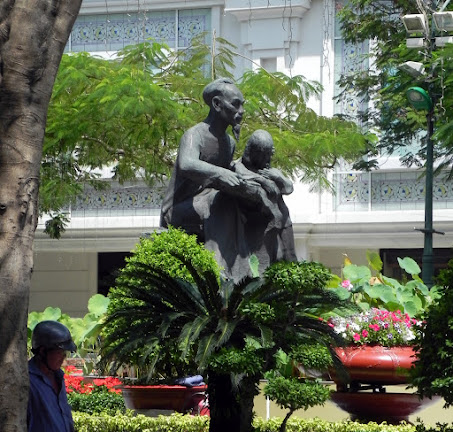 |
| Statue of Ho Chi Minh reading to a child in front of the Communist Party of Vietnam headquarters in Ho Chi Minh City (formerly Saigon). |
So what about the Vietnam War and how do they feel about Americans visiting?
Most of us probably remember this iconic image from the end of the Vietnam War:
 |
| Evacuation of CIA station personnel by Air America on April 29, 1975. |
 |
| The building is still there but now surrounded by modern multi-story buildings. |
One of the most famous must see sights is the War Remnants museum and its presentation of the Vietnam War. Yes, it is a very one-sided presentation but when war and the atrocities associated with it are present by the country that suffered through the war one should expect it to be rather one-sided. But the feeling and the general mood in Vietnam is one of progress. Our local Vietnam guide said "we forgive but do not forget". And so they have move forward both economically and politically. All westerners are welcomed to visit Vietnam as it is one of the best revenue streams the country has outside of rice exports. This does not mean that all is forgiven and the Communist Party in Vietnam interacts with all Vietnamese citizens equally.
The remainder of our stay in Vietnam (Mekong River cruise) our river guide tried to explain about the economic progress of Vietnam since the end of the Vietnam War. Agriculture is the largest sector of the Vietnamese economy but the farmers do not own the land they farm. Đổi Mới (Renovation) is the name given to the economic reforms initiated in Vietnam with the goal of creating a "socialist-oriented market economy". Not really certain what this means but during our 2002 visit to China something similar was said to us but the phrase used then "China is now more pink than red." This line of thinking has allowed Vietnam much economic success and good trade relationships with most of the Western world. But there are still some restrictions as to who gets to hold a government job and many times it depends on what religion is practiced. As long as the religion is not Catholic then a government position is possible. Interesting as Catholicism is the second most practiced religion in Vietnam but then this distrust goes back a few centuries. Guess it is another way to separate the Church from the State.
So far I have mentioned that our trip included visiting two communist governments (China and Vietnam) and a constitutional monarchy government (Japan). So what about the other two countries that also have constitutional monarchies - Cambodia and Thailand?
 |
| Royal Palace in Phnom Penh |
Our arrival in Cambodia was shortly after the funeral services for Norodom Sihanouk or as referred to by the many locals as "The King-Father of Cambodia". Sihanouk has held so many positions since 1941 that the Guinness Book of World Records identifies him as the politician who has served the world's greatest variety of political offices. These included two terms as king, two as sovereign prince, one as president, two as prime minister, as well as numerous positions as leader of various governments-in-exile. He served as puppet head of state for the Khmer Rouge government in 1975–1976.
Pictures of the late monarch were everywhere and many citizens were still openly depressed that he had passed away. Here is a leader that seemed to be able to leave town just as the organic matter was about to hit the rotating blades but was being mourned as the greatest leader of all time. Really?!?
As I mentioned in my post "Khmer of Cambodia" the Cambodian people have suffered greatly throughout their long history of invasions by the neighboring counties but they all still seem to remember the "good days" when they were part of the French protectorate and not the horror of the Killing Fields. Sihanouk was a man of many talents and he frequently shared his passions with the other citizens of Cambodia, like performing songs in Khmer, French, and English as well as motion pictures. This did make him more like the common citizen thus well loved.
Now while on the subject of a ruler being well loved by a country's citizen let's move on to Bhumibol Adulyadej also known as Rama IX the current reigning King of Thailand. Having reigned since 9 June 1946, he is the world's longest-serving current head of state and the longest-reigning monarch in Thai history. Yes, very impressive but....
...the King is legally considered "inviolable", and lèse majesté offence against the dignity of the monarch may be punished by imprisonment.
So what is Lèse majesté, i.e. the crime of violating majesty. This law has been prohibited by the Law of Thailand since 1908. In 1932, when Thailand's monarchy ceased to be absolute and a constitution was adopted, it too included language prohibiting lese-majesty. The 2007 Constitution of Thailand, and all seventeen versions since 1932, contain the clause, "The King shall be enthroned in a position of revered worship and shall not be violated. No person shall expose the King to any sort of accusation or action." Thai Criminal Code elaborates in Article 112: "Whoever defames, insults or threatens the King, Queen, the Heir-apparent or the Regent, shall be punished with imprisonment of three to fifteen years."
This may not seem like a bad idea, however, what is missing is a definition of what actions constitute "defamation" or "insult". From 1990 to 2005, the Thai court system only saw four or five lèse majesté cases a year. From January 2006 to May 2011, however, more than 400 cases came to trial, an estimated 1,500 percent increase.
The 1956 movie "The King and I" is still banned in Thailand as are all of the versions produced since. Other banned writings include Blogs (I am not planning another trip to Thailand) or web links to books or articles deemed critical of the monarch.
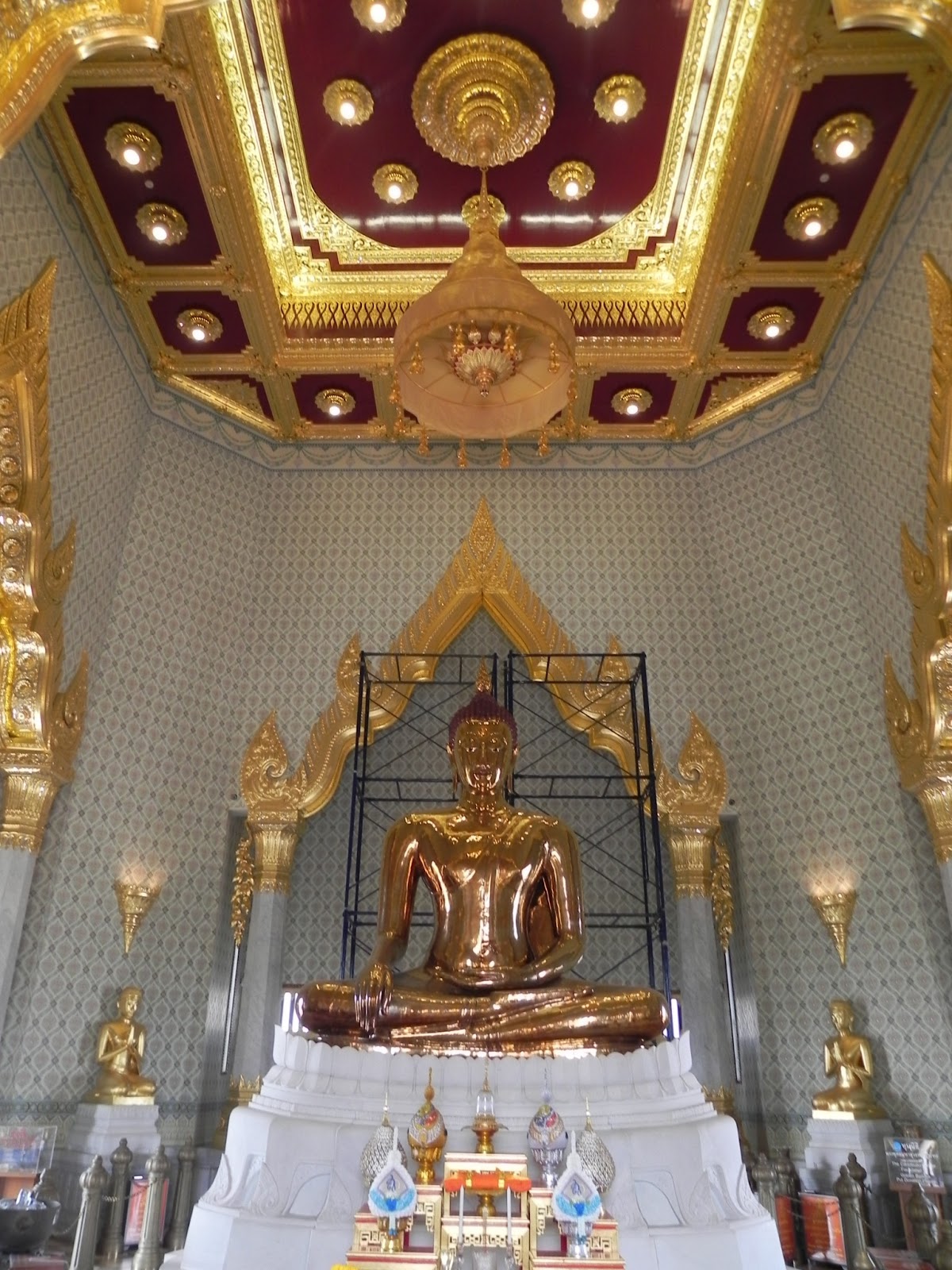 |
| Golden Buddha in Bangkok with Queen's emblem as part of the offerings. |
...the King is legally considered "inviolable", and lèse majesté offence against the dignity of the monarch may be punished by imprisonment.
So what is Lèse majesté, i.e. the crime of violating majesty. This law has been prohibited by the Law of Thailand since 1908. In 1932, when Thailand's monarchy ceased to be absolute and a constitution was adopted, it too included language prohibiting lese-majesty. The 2007 Constitution of Thailand, and all seventeen versions since 1932, contain the clause, "The King shall be enthroned in a position of revered worship and shall not be violated. No person shall expose the King to any sort of accusation or action." Thai Criminal Code elaborates in Article 112: "Whoever defames, insults or threatens the King, Queen, the Heir-apparent or the Regent, shall be punished with imprisonment of three to fifteen years."
This may not seem like a bad idea, however, what is missing is a definition of what actions constitute "defamation" or "insult". From 1990 to 2005, the Thai court system only saw four or five lèse majesté cases a year. From January 2006 to May 2011, however, more than 400 cases came to trial, an estimated 1,500 percent increase.
The 1956 movie "The King and I" is still banned in Thailand as are all of the versions produced since. Other banned writings include Blogs (I am not planning another trip to Thailand) or web links to books or articles deemed critical of the monarch.
- May 2011. Joe Gordon, an American citizen born in Thailand as Lerpong Wichaikhammat, had lived in the United States for thirty years before returning to his homeland where he was arrested on charges of insulting Thailand's monarchy — in part by posting a link on his blog to a banned book about the ailing king. Gordon is also reportedly suspected of translating, from English into Thai, portions of The King Never Smiles – an unauthorized biography of King Bhumibol Adulyadej – and posting them online, along with articles he wrote that allegedly defame the royal family.On 8 December 2011 a court in Thailand sentenced Joe Gordon to two and a half years in prison (halved from five years due to pleading guilty) for defaming the country's royal family by translating excerpts of a locally banned biography of the king and posting them online. The 10 October AP report on Joe Gordon's plea adds that "Yingluck’s government has been just as aggressive in pursuing the cases as its predecessors.". On July 10, 2012, Gordon received a pardon from the King and was released from jail.
- March 2012. Akachai Hongkangwan was arrested for selling VCDs containing a segment of the Australian Broadcasting Corporation Foreign Correspondent series. Australian foreign correspondent Eric Campbell and ABC’s entire Bangkok bureau had been banned from entering Thailand after they aired an investigation of Bhumibol's role in the military's violent 2010 crackdown on protesters. The report was broadcast only in Australia.
- January 2013. Somyot Prueksakasemsuk was sentenced to 10 years in prison, convicted of publishing two articles under a pseudonym that made negative references to the crown in his now-defunct anti-establishment magazine, Voice of Taksin, which was launched in 2009 to compile political news and anti-establishment articles from writers and contributors.
It must be good to be the King ;-) I certainly hope that as Americans we have the sensibility not to enact such restrictive laws but I am afraid we have already lost that battle as our freedom is being monitored by our government through the use of electronic spying and UAVs.
Subscribe to:
Posts (Atom)