Wednesday, March 20, 2013

Khmer of Cambodia

Sometimes a bad event is a good thing and here is mine. My last hastily published blog posts about our adventures in China were done with a limited amount of sleep, no we were not celebrating Lunar New Year but the rest of SE Asia appeared to be enjoying the festivities. For my travelblog I wanted to write about what we saw and did in either a region or a city but as we were leaving Saigon my netbook gave up the ghost and became a 3 pound brick that I got to carry around the remaining two weeks of my trip. The good part was that this kept me from writing about Saigon and the Vietnamese cities along the Mekong before experiencing the Khmer culture of Cambodia and Thailand thus providing me with contrasts and comparisons.

Depending on your views of either the Vietnam war or the aftermath of the war Ho Chi Minh (Saigon) is a city to be explored and one that has both a view to the past and one to the future. We did not include a visit to north Vietnam this time so can't comment on what daily life is like in that area nor do I know what Saigon was like during the period while the French and then the Americans were occupying South Vietnam. But more about Saigon in another post but until then just know that a Dragon dance practice at 6 am is not the best way to be woken up after not having much sleep the night before.


The topic of this blog post is Cambodia and its people. The country really impressed me as people with resilience as you look at the cities and countryside.  This country is a third world country and appears to be poorer than India at many levels. Cambodia has been ravaged by civil war, considered an unsafe tourist destination until ten or so years ago, subjected to cruelty by the neighboring countries, genocide by the Khmer Rouge (their own kin), but they have bounced back and everyone appears to have a positive view of a better future Cambodia.  One of the most popular touristic destination is the Angkor archaeological site. Tourism provides income to more than the locals but also includes farmers who come to earn a living during the dry season then return to their primary source of income during the wet season - agriculture. The closest city to the Angkor complex is Siem Reap (Fall of Siam) and here it is focused on the tourism trade. Another touristic site is Phnom Penh, a city where the recent past is on display both  events very different but related. By this I mean the death of King Norodom Sihanouk- the Father King and the genocide memorials.  New factory sites were popping up all over the Cambodian countryside. Most were still being constructed but it was not clear how many locals would be employed once the construction phase was completed nor the type of manufacturing would be done. It did appear many would be warehouses but other looked like they would become garment factories. As with most silver linings there is a dark cloud of history and future environmental payments behind it.


Typical village along the Mekong in Cambodia

Our cruise up the Mekong on the RV AMALOTUS started outside of Saigon where we boarded our riverboat.


The ship's crew consisted both Vietnamese and Cambodians with the passengers on our cruise being mostly Swiss Germans, a few French, a German couple, other Europeans, two couples from Australia and two American couples. With the exception of a few most were middle aged and fairly fit. The Swiss German group had their own tour guide as well as Swiss German speaking local guides. The English speaking group (the German couple went with the English speakers as they didn't understand Swiss German) had local guides for Vietnam and Cambodia but not a tour guide. I don't think that either of our local guides were affiliated with a political party or were government minders as there were several political comments made by both. However they did seem to tow the party line regarding current administrations.

The first part of the cruise was in the Vietnam portion of the Mekong with daily excursion to a local village, fish farm, factory, or market to see daily life and this was repeated in Cambodia. Those who have been on cruises before know about shore excursions and how packs of tourists scurry from one site to another like coveys of quails. This was the oft repeated scene when our groups marched through tiny villages, markets, farm and farmer's houses, small factories, and fish farms. In both Vietnam and Cambodia the children came running out to wave and say hello to us as we passed by in the villages and along the river.

While in Vietnam these excursions seemed more like "Look how well we are doing! We are able to farm and sell our goods and make a living. Our government helps its citizens." But once we entered Cambodia these visits were not to villages or farms that were overly prosperous.  I was torn between feelings of  'I have or possess too much and these people have nothing" to "What can be done about this poverty!" I felt very conflicted about the excursions. The zoo-like aspect of it was unsettling, but I also felt that skipping it would have meant taking a stance that basically said, “We love visiting your beautiful country, but we’d rather not see the human impact of your formerly oppressive government’s policies.”

Cambodia needs the tourism but as I mentioned earlier there much missing in Cambodia which dates back to the genocide by the Khmer Rouge and the following civil war. There are very few people over the age of 60 in Cambodia with a majority of the population between the ages of 15-54 (58%, median age 23). The GDP spent on education is around 2% and schools are not very well equipped. Often it was not possible to tell if any children attended school as it appeared that they were out trying to sell something to a tourist. So one of the easiest ways to make money is tourism and its associated ancillary businesses. But who will manage these enterprises? In Phnom Penh the Choeung Ek (Killing Fields) memorial is managed by JC Royal Company - a Japanese owned business.


... JC Royal Co., is expected to "increase revenue for the state and develop and renovate the beauty of Choeung Ek killing fields." JC Royal is to pay the municipality of Phnom Penh $15,000 a year. In return, it will be allowed to jack up entrance fees, charging foreign visitors up to $3 instead of the current 50 cents.

http://www.time.com/time/magazine/article/0,9171,1047552,00.html#ixzz2Nf4sa2sm


Our group visited Choeung Ek and Tuol Sleng on the same day, both very impressive and depressing at the same time. The difference between the way the two sites are managed is significant. Granted Choeung Ek is outside of Phnom Penh but it seems more quiet and respectful of the atrocities committed there than the poorly presented Tuol Sleng. 


The Angkor Archaeological Park ticket sales is another location where a private business is in control. The temples and their restoration are not managed by this group but only a small fraction of the monies generated from the ticket sales  is returned to the site. You can't see the temples without a ticket as the ticket concession has ticket examiners in front of each major site and can ask at random to see your ticket. So the locals make money by selling trinkets or at the restaurants in front of Angkor Wat. This area has been cleared of landmines but they suggest you not go into the jungle. More about the landmines later.


One of our last excursions along the Mekong included an ox cart ride back to the ship. Again as we were trundling down the dirt road I felt like I was on display with all of the children chasing after us. The children at first tired to "give" a small item like drawing or folded flower to us for a small amount of money or candy but they were mostly curious and friendly trying out their limited English.


My driver it turns out spoke English and had gone to school for a while but now was a farmer and wanted to proudly point out all of the local points of interest. One of a building that looked like it had seen better days was the local maternity ward and the dirt road we were bumping down had just been finished - washed out from the previous monsoon season. A number of villagers had electricity - at least one fluorescent lightbulb and TV (flat panel) were seen in the houses with electricity.  There isn't a centralized trash pick up so plastic bags were either blowing around or found along side of the road with non recyclable trash.

There is very little waste of natural resources - like using rice straw as fuel (the burning of rice straw is one of the major contributors to the air pollution problem in SE Asia second only to automobiles and the hordes of scooters). Floating along we had noticed that in the Cambodian portion of the Mekong was the use of aerosol cans as floats for the fishing nets. As we passed through Kampong Tralach I saw where a local was taking the plastic caps off the spray cans (Raid) and attaching them to fishing nets. I can only imagine that someone thought this was a form of recycling but didn't either think or was aware of the residual pesticide in each can or the future pollution problem once these cans rusted through. This form of being resourceful is what I meant by the darkside. More tourists means more trash that can be repurposed to generate more income......

More later about the "party line" but check the other tabs for pictures. Not all have been posted here on this blog yet.



Sunday, February 17, 2013

But it is a dry cold

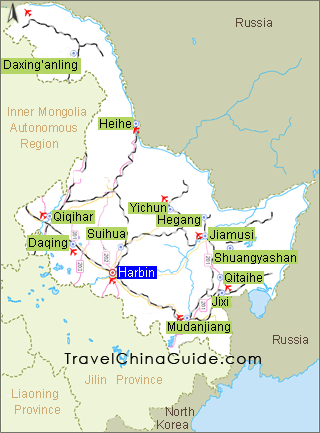
Harbin Map

Harbin, China is about 300 miles from the Russian border in Heilongjiang province and is is the capital and largest city of Heilongjiang Province in Northeast China, as well as the tenth most populated city in the People's Republic of China. According to the 2010 China census data, the city's urban area has 5,878,939 inhabitants, while the total population of the sub-provincial city is up to 10,635,971. Harbin serves as a key political, economic, scientific, cultural and communications hub in Northeast China.

Harbin, which is originally a Manchu word meaning "a place for drying fishing nets", grew from a small rural settlement on the Songhua River to become one of the largest cities in Northeast China. Founded by Russia in 1898 with the coming of the Trans-Manchurian Railway, today known as the Chinese Eastern Railway, the city first prospered as a region inhabited by an overwhelming majority of the Jewish immigrants. It is known for its bitterly cold winters and is often called the "Ice City." Harbin is notable for its beautiful ice sculptures in winter and its Russian legacy, and it still plays an important part in Sino-Russian trade today. In the 1920s, the city was considered China's fashion capital since new designs from Paris and Moscow reached there first before arriving in Shanghai. In 2010, it was declared a UNESCO "City of Music".

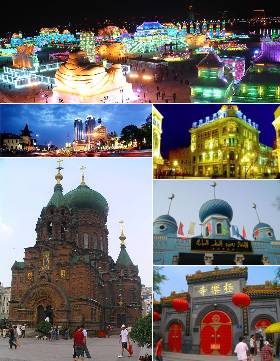
File:Harbin montage.png

Before the Cultural Revolution there were several Russian Orthodox churches in Harbin but today only one survives - Saint Sophia Cathedral. As of 1997 the cathedral was turned into the Municipal Architecture and Art Museum (Harbin Architectural Art Gallery), showcasing the multi-cultural architectural developments of Harbin throughout the ages. 


The average snowfall is around 5 inches but the average winter daytime high is 8 F with an overnight low around -18 F and the air is very dry. Cold temperatures start in November and it really doesn't start to warm up until April.  The Songhua River freezes to a depth of 40 inches which is a good thing as this is where the ice blocks are cut to build the ice sculptures and moved by trucks to the Ice and Snow World festival site. The ice sculpture building begins in mid-December and they go on display to the public early January until late February depending on weather conditions.  The best time to view the sculptures is in the evening when they are illuminated from within with multi-colored lights. It is like looking at fairy tale castles in a deep freeze. 

Harbin Ice Festival.jpg

Everyone is dressed for the extreme cold and taking pictures requires some finesse to keep your fingers and the camera battery from freezing.  By the end of our one hour tour in the evening our chins were numb but our down parkas, double wool pants, ski gloves, double ski socks, long johns, and ski hat kept us toasty. 


BTW one of the local favorite treats sold during the winter is popsicles. 


The next morning we dressed again in our layers and ventured out to see the snow sculptures at Sun Island and the Siberian tigers at the Siberia Tiger Park.


Here in Harbin I was surprised to learn that the local beer, Harbin beer, through Anheuser-Busch is a sponsor of the NBA.  Yes American basketball. The brewery is owned by Anheuser–Busch InBev, which has helped to export Harbin beer to European and North American markets, but in comparison to Tsingtao Beer or Zhujiang Beer its share in these markets is minor. Shaq is their main spokesperson. But then you may already know this if you watch TV which I don't. This was a promotion campaign for the 2013 Chinese Lunar New Year celebration.


It's a small world


I wasn’t surprised that there are McDonalds and Starbucks in Japan but I was certainly surprised to see the following American restaurants  and stores in Japan.


There are also about 578 Denny's restaurants in Japan.


Big Boy Japan owns and operates 296 locations throughout Japan under four restaurant names: Big Boy (199 stores), Milky Way (50), Victoria Station (43), and Grill Dan (4). From what I have read there are not many Bob’ s  Big Boy left in the US. In Japan eating beef burger is a favorite dining experience.


There are several small convenience stores in Japan and I remember several when I was living here back in the late 60’s but then they tended to be family owned. Here are some that we all know and stopped by to buy our Slurpees in the US. 


It is a small world after all.

The Great Firewall of China, Fireworks, and Populaces


When we started this adventure we knew that we might have problems using the internet in China. What I didn’t expect was that I would not be able to gain access to Blogger or any other blog site with the exception of those permitted by the Chinese state run internet, Sina Weibo. This has put a real crimp on many other activities like uploading photos using Google. This is not too surprising as Google is not on friendly terms with the Chinese government. What I also found surprising was that there are microblogs being written by US athletes (Kobe Bryant) and other Western celebrities published in SinaWeibo. I haven’t red any of them but per China Daily (a government approved English language newspaper) these microblogs are being written in hopes of expanding their Chinese fan base.

This is our second trip to mainland China, this trip and the previous one we were given the standard Communist party line but in neither case did we feel we were being monitored while speaking with our guides.  The two China guides assigned to us this time have traveled to the US and our Shanghai guide has even been to Walnut Creek (though she was surprised we didn’t live in a gated community). When talking to the guides about where they went while in the US, it appears that their main goal was to shop for designer goods at outlet malls and to go to Las Vegas. This was quite different than what our Japanese guides said they did which was to go visit our National Parks with shopping as a secondary excursion.  I should mention that freedom to travel in China by the Chinese is permitted and in fact was a problem for us as our stay coincided with the Lunar New Year celebration.  Many Chinese spent their holiday in Shanghai. However, personal relocation from one part of China to another is not as easy.  This is in part to control the population growth and resource needs of an area. China is still enforcing the one child program with a few exceptions for ethnic groups.  If a person or family wants to move from one city to another in a different province permanently they must first request permission from the local magistrate to obtain residency.  There are many cases where “undocumented” workers have moved without seeking such permission but if they have children the children may be denied acceptance into the local college or other free or subsidized privileges given to “documented” citizens.   Our Harbin guide seemed confused when I mention that Dick’s family had originally been farmers but his family had moved away from the farm to different states.  He asked where we lived as he assumed that the San Francisco area was not a farming region and I told him that much of the Bay area had been farm land but was no longer. He had this look on his face of not comprehending what I was saying. I didn’t think his question was unusual nor his look of confusion until later when I realized what he didn’t understand was that in the US we can move freely from one state to another.  His grandfather had to request permission to move to Heilongjiang province.  

Chinese New Year is a very busy time in China with 200 million people traveling from one part of the country to another to either see family or just to vacation. This is the largest movement of humans in modern times and it occurs annually in China during the Spring or Lunar New Year holiday season. Shanghai was full of people to the point it was very difficult to get around without being shoved when “walking” through some of the more popular sights. 


Every night there were several rounds fireworks (many displays provided by the local government) being shot off until daybreak. The air in Shanghai was hazy to begin with from factory and car pollution so the added smoke from the firework displays made the very smoggy in Shanghai.  The evening of the 13th was the nosiest and unfortunately the next morning we had a real early flight so we didn’t get much sleep when the popping and banging was done in front of our hotel (we also had a front facing room).


In Harbin we again experienced the fireworks outside our hotel in the evening but it was not as loud or large. Fireworks were being sold on many of the Harbin street corners. Again per the state controlled newspapers the displays were less than years previous as the government is encouraging consumers to show some restraint in spending.  This is not being demonstrated at the various dining halls. We ate one in Shanghai and one in Harbin and in both cases I saw lots of food being wasted. This is not unusual but again the Chinese government is suggesting that this type of wasteful behavior be curtailed. Good luck with that as this is the time of the year in China when feasting is a sign of wealth and to be able to throw away food is a sign that you have money to burn. Other obvious signs wealth expressed at this time oc the year is buying designer labeled goods. On our flight from Shanghai to Harbin there were several people wearing new designer clothes carrying bags of recently purchased goods. 

With everyone traveling in China and many places being overcrowded this was a major cultural difference between Japan and China. In Japan personal space is respected and politeness shown at every occasion. Not in China. The idea of queuing and waiting your turn is very different and shoving is common.  If you are standing in line in a restroom don’t expect to be able to use the next available toilet as the Chinese tend to queue in front of a stall door and when it opens it is yours to use. So if you think you are at the head of a line you are in reality queued for whatever door you happen to be standing in front of. I made this mistake only once and learned. BTW bring your own TP as none is provided in the stalls but there may be a big roll available when you first enter the restroom.  


In Japan you will find Western style toilets in most places with a few squat toilet for women who wear kimonos to use but in China more often than not it will be a squat toilet and not very clean. All of this is not to say that China is backwards it just has a different view of how things work, take driving for instance. Traffic lanes seem to be discretionary as it was very common to see cars going down the freeway straddling two lanes or driving below the speed limit and without headlights on. Per our guide in Harbin people buy cars without having a license or any idea of how to drive so they learn as they go. In Japan you will see driving schools with practice driving courses. The Japanese traffic and the driving rules are very tough so getting license is difficult in Japan.  I didn’t see any accidents or many dented cars in China so the system must work whereas we did see a really bad accident in the middle of Tokyo.  With the cost of fuel, insurance, and the limited space for parking many Japanese don’t own cars and use public transportation. But in China public transportation is not always available so people buy cars to get around. There are about a 1000 new cars on the road each day in China.  Subways are being built in most of the major cities to address the problem but in many cities these projects may not be completed for another decade.


Guess the US and China has a lot in common as far as public transportation goes.

Monday, February 11, 2013

Oh yeah, here is where we will be going (gone)

Riding on the pirate ship on Lake Ashi

Many of you already know that this trip is one where we are on the move almost every other day. This was not our choice but it just worked out that way so that we could incorporate the two different Snow and Ice Festivals in Japan and China.

Below are the cities we will visit and the arrivals dates with the number of day at each cities. For some cities this will not be enough time to see all that we want but it will give us a reason to come back again.

Day 1-3 • Osaka 2/03/13
 
Day 4-5 - Sapporo 2/06/13
  
Day 6-7 - Tokyo 2/08/13
  
Day 8-9 - Kyoto 2/10/13  
 
Day 10-11 - Shanghai  2/12/13
 
Day 12 • Harbin 2/14/13 
 
Day 13 • Shanghai 2/15/13 
Day 14-15 • Saigon  2/16/13 
  
Day 16-22 • Mekong River cruise  2/18/13
This is an 8 day 7 night cruise up the Mekong (Vietnam to Cambodia)
  •  Day 17 • CAI BE - VINH LONG  2/19/13
  •  Day 18 • SA DEC - TAN CHAU 2/20/13
  •  Day 19 • TAN CHAU - BORDER CROSSING 2/21/13
  •  Day 20 • PHNOM PENH 2/22/13
  •  Day 21 • CHONG KOH - OUDONG - KAMPONG TRALACH  2/23/13
  •  Day 22 • KAMPONG CHHNANG - TONLE SAP LAKE 2/24/13
Day 23-24 • SIEM REAP 2/25/13

Day 25-28 • Bangkok  2/27/13

Day 29 • Departure to SFO  3/2/13 
Arrive 910 am, whew!!

Sunday, February 10, 2013

It is how cold?


The 64th annual Sapporo Snow Festival began on Tuesday the 5th, featuring 216 snow sculptures at three sites, including Odori Park, the main venue. Here you can see how warm it was when we went out to see the exhibit and yest that is the Hawaiian tourist booth and the temperature is in C not F (-4 C is equal to about 25 F and 25 C is 77 F). BTW it is the dry season here, lol. At one point my small camera stopped working and had to warm up before it would start again.

Just a few days before the opening of the Festival there was a 6.4 earthquake and then it rained. The rain melted parts of some of the smaller sculptures and many had to be repaired just hours before the judging.


Many of the public information signs were written in four languages - Japanese, English, Chinese, and Korean but for the snow sculptures only Japanese was used. 

While we were out viewing the sculptures a snowstorm hit so we didn't get all of the names of who sculpted what so many of the pictures below don't have much information. The one really great thing that Sapporo has built was an underground passage way that went from the Sapporo Train station to Odori Park allowing us not to have to walk the whole way back to our hotel in the snowstorm. This passage way also connects the various subway lines as well as allows more shopping and pop-up galleries to exist.  

So our next Ice and Snow Festival is in Harbin, China which is even colder than Sapporo!! I wonder what they will suggest to eat to stay warm, hmmm?!? At the Sapporo festival I saw several people buying roasted ears of corn served in plastic bags which many people were using them to keep their hands warm. There was a booth selling candied nuts where the two guys preparing the nuts were from America. Guess they were trying to get a start in the Japanese market. There are several American restaurant chains here and I will blog about them in another post.


It was a balmy warm snowy, freezing day 
We all remember Ultraman, right?!?!
Wat Benchamabophit
Brushing off the new snow, good luck with keeping up with the snow as it snowed a foot on this day

A close-up to show the detail of the Thai sculpture.

The National Chiang Kai-shek Memorial Hall 

Great to be so cool!

Kabuki-za in Ginza is the principal theater in Tokyo for the traditional Kabuki dramas

This was the US Navy's entry

Yep, it must be funny to see all of the freezing people


No idea why a stomach was sculpted.

Oregonians Wild Ride - Portland is a Sister city to Sapporo
  
There are chains on the wheels and the other two wheelchairs have skis instead of wheels
  
One of the many ubiquitous vending machines in Japan 


Adding some touch-ups to the Finnish entry.

One of the sculptures that required some repairs - Bali

Hey, look it is my old employer.

Here is an underground passage way between our hotel and Odori Park. One of the best ways to get around.

And after a cold day which plastic dinner should I have?